Showing posts with label Grist. Show all posts

Monday, October 26, 2009

Awesome office photos


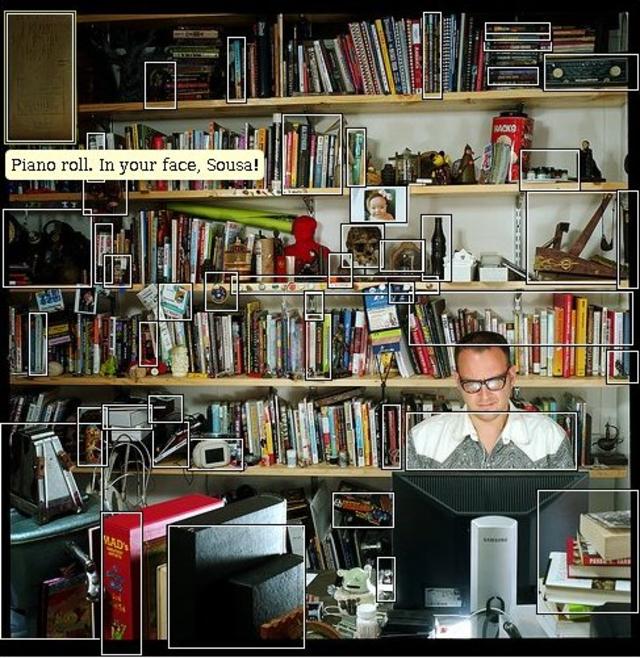
I found this on Cory Doctorow's website Craphound and I think it's cool.

"One of Jonathan's (Johnathan Worth commercial photographer) photograph pictures showed me in my office, and I went a little Flickr-crazy marking up the photo with notes explaining what everything was. I tweeted the photo, and lots of people came by to see it -- several thousand, some of whom ended up offering Jonathan paying work. It was a win all around."


(Click on the photo for full image, including Cory at work.)

Here is the the link to the photo on flickr with Cory's notes.
L

MEH

I wrote this last night while pulling what was left of my hair out of my head. I wasn't trying to stimulate hair growth. I was extremely frustrated with the review I had been attempting to write. So much turmoil in my personal life right now and it is starting to seep into my dreams and is playing havoc with my imagination. I'm thinking things are going to be better soon. I have the next three days off from my money job and I think I'm going to submit some work tonight. I need to think beyond the thing that is weighing so heavily on my mind. It is even difficult for the aloof part of me that observes everything to remain aloof and unbiased when it comes to this one event that involves a member of my family. A looming eventuality that I have been dreading for months is finally here and I don't want to deal with it. Usually, I have either the solace of my money job to hide in when the family life is chaotic, and when my money job is driving me nuts I have the safety of my family and home where I lick my wounds and regather my strength. These last few months I haven't had stability in either area. So I'd like to turn to the shelter of my office and the sanctum of my imagination and literature, but even those things are not providing me with the peace and I hate to admit, the escape I desire.
L

Friday, October 2, 2009

John Osbourne and Kitchen Sink Dramas

I think of John Osbourne's play, Look Back in Anger when Kitchen Sink Dramas are mentioned. I'm reading the excellent John Heilpern bio of Osbourne called, John Osbourne: The Many Lives of the Angry young Man as I write this.

More lit mags links

More lit mags looking for submissions.

and more

Interesting stuff

San Fran lit mags

Lit mag central

Much more, some repeated.

And they're every where.

Literary Editing & Magazine Publishing, An Editor’s View.

http://noggs.typepad.com/tre_prime/2009/01/only-read-by-literary-people.html

Lit mag that
seeks play submissions.


More lit lists.


Lit lists from EWR (every writer's resource)

And even in Kentucky.

Friday, September 25, 2009

And now hear this...MONU

Found this link on Warren Ellis.com. I wish I had more time to check out Monu (here you can browse Monu's 11th issue on YouTube)in more depth.

RIBBIT

If you're feeling froggie jump to this story. Are we seeing natural evolution at work, or mutations caused by the most dangerous animal of all...us?

More cryptozoology here.

L

Thursday, September 24, 2009

Artifacts or Hoax? And Then Came the Comments.. and a bunch of stuff.

I found this on Warren Ellis's web site. And while the subject matter is fascinating. I find the reader's comments so much more intriguing. Their cruelty and sarcasm astounds me. Their grammar, spelling, syntax and punctuation alarms me. Read some comments and enjoy the decay of Western civilization. Hey, at least we're going down entertained.

Now this is some weird shit. All I can hear is the theme music from the David Carradine seventies tv show Kung Fu.

Oh and this is just crazy, a poisonous spine, really?

Here we have the ongoing argument about literature versus mainstream fiction, and specific genres like science fiction.

This little tidbit I found on io9 could be great and it could be like this piece of petrified poop. The Moleman spouting Shakespeare is cool though. Anybody remember this 1979 goofy Captain America TV movie? When I was an eleven year old kid I loved it, and I have to admit, I still like it in a "Batman and Robin" 1960's TV series way. POW! WHACK! SMASH! WHAM!
L

Saturday, January 17, 2009

The Prisoner Yesterday and the Future

Patrick Macgoohan has passed and we have lost a television series icon. AMC is running the entirety of the Prisoner online and they are ready to launch a remake of the series. I'll have to watch the show first before I can judge it. I am skeptical. Remember the Pretender? The Prisoner series worked so well due to the reflection of the time period...Don't know if that sense of "innocence lost" can be repeated. We have become a very jaded demographic of viewers where nothing surprises or shocks us anymore. Ah, early morning ramblings. Anyway, besides being an actor in the series, Macgoohan created it and wrote and directed many episodes. Here is a link to AMC's online episodes http://www.amctv.com/originals/the-prisoner-1960s-series/

L

Thursday, December 18, 2008

SHOW DON't Tell

This one was posted in Kungfu Monkey. Much like it!


Tuesday, December 16, 2008
Waid Wednesday #2: 101-A (a.k.a. "More Than Words")
Novelist walks into my office. Relatively famous, not as famous as Aforementioned Screenwriter, but a multiple award-winner in his genre nonetheless. And he’s immediately on my bad side because the comics script he has handed me is the dullest thing I have ever read, and I used to be a legal secretary.

It isn’t a bad story. To the contrary, the conflict is clear and intriguing and the plot moves along at a good clip. But the Ambien on the page comes from the fact that the writer’s a novelist. He’s accustomed to introducing his characters by writing hundreds of riveting words describing how they view the world, what their hopes and dreams are, and what’s going on inside their heads from moment to moment. But there is no room for that on the comic book page, so he just left it out, and now I’m holding a script starring a bunch of plot puppets who are indistinguishable from one another, who don’t reveal themselves through action, and who are interesting only in the writer's head.

Comics is a visual medium. That means the writer has to find a way to externalize the conflicts--literally or, with practice, symbolically--and not leave them locked inside the protagonist. I’m not saying punches have to be thrown--not every comic is or need be about Spider-Man--but if comics is the avenue through which you want to tell your story, it had better be a story that is, in its telling, visually interesting. If it isn't, you have chosen the wrong medium. I have been in awe of E.M. Forster's talent since I was fourteen, but I can imagine nothing more tedious than a graphic novelization of A Room With a View.

It sounds absurdly obvious, but I am so continually confronted with writers so in love with their dialogue that I'm going to say it again: comics is a visual medium. Bring every important character on stage by having him or her doing something--spinning a basketball, operating an electron microscope, taking a fistful of vitamins, anything--that instantly tells us something about them. When there's conflict, find a way to make it visual. Witty dialogue and clever repartee are priceless, yes, but probably more than in any other medium outside of, oh, mime, comics depends on the writer showing rather than telling. So give your artist interesting things to draw. Can this dramatic revelation happen in, say, a planetarium rather than in a hotel room? Can this confrontation happen on a Ferris wheel instead of a generic alleyway? Can these characters be acting rather than reacting?

One last time: comics is a visual medium. Use that. I am a huge, huge believer in page one of any comics story of any genre having an unusual image that will grab the reader and draw him in. It doesn’t have to be “super-heroey”--in the right story, a shot of a woman looming over an empty crib has just as much impact as, I don’t know, Superman punching a meteor--but by now, any comic book that opens up with four pages of guys in business suits standing around a generic boardroom is just death. D-E-A-T-H. Every issue, we have twenty-two pages, give or take, to tell readers a story that they paid good money for, so as a writer, I get very nervous opening with (or, once I’ve opened, spending more than about two pages on) something you can see on TV every day for free, without my help. Always think visually. Always, always look at your scenes once they’re drafted and ask yourself if they have more visual impact than two guys in business suits standing around a boardroom. If not, rewrite.
Next: Economy Of Storytelling
Posted by Mark Waid at 9:34 PM

Tuesday, December 16, 2008

Robotics research

The study of motion can be divided into kinematics and dynamics. Direct kinematics refers to the calculation of end effector position, orientation, velocity and acceleration when the corresponding joint values are known. Inverse kinematics refers to the opposite case in which required joint values are calculated for given end effector values, as done in path planning. Some special aspects of kinematics include handling of redundancy (different possibilities of performing the same movement), collision avoidance and singularity avoidance. Once all relevant positions, velocities and accelerations have been calculated using kinematics, methods from the field of dynamics are used to study the effect of forces upon these movements. Direct dynamics refers to the calculation of accelerations in the robot once the applied forces are known. Direct dynamics is used in computer simulations of the robot. Inverse dynamics refers to the calculation of the actuator forces necessary to create a prescribed end effector acceleration. This information can be used to improve the control algorithms of a robot.

In each area mentioned above, researchers strive to develop new concepts and strategies, improve existing ones and improve the interaction between these areas. To do this, criteria for "optimal" performance and ways to optimize design, structure and control of robots must be developed and implemented.

Saturday, July 12, 2008

grist: autism

A new genetic analysis of large, inbred Middle Eastern families found that genes linked to a heightened risk of autism are crucial to a child's ability to learn.

A group of scientists, led by a team at Children's Hospital Boston, has pinpointed six new genes that may contribute to autism, a disorder characterized by asocial behavior, difficulty communicating and repetitive actions that affects an estimated one in 150 children born in the U.S. each year. They report in Science that all of the linked genes are involved in forming new and stronger connections, called synapses, between nerve cellsin the brain, which is the biological basis of learning and memory formation.

"We're showing, on the one hand, that autism seems to have a large genetic component," says study co-author Christopher Walsh, chief of genetics at Children's Hospital. "But, the genes that are involved are actually those that are involved in responding to the environment and learning."

The findings, Walsh says, reinforces the importance of early diagnosis of autism and intervention, particularly behavioral therapy and learning in enriched environments through repeated activities. Performing these sorts of tasks may help strengthen cellular connections, compensating for the malfunctioning genes.

The researchers studied 88 families in which one or more children had been diagnosed with autism, and the parents of each autistic child were cousins. Marrying second and third—and even first cousins—is not uncommon in the Middle East, and by studying such families scientists were able to track recessive genetic traits (caused by mutations that only affect individuals with two copies of the flawed genes). Such traits occur far more frequently in inbred families than in others.

The team found a total of six mutations affecting genes that had previously not been linked to autism. The mutations came in the form of deletions, where part or all of both copies of the genes were missing in a child with the disorder. All of the genes are known to be involved in parts of the same process: creating and strengthening synapses.

Normally, when nerve cells (neurons) activate in response to an environmental factor (such as processing a new face or a new sound), synapses between two active cells change to provide stronger connections so the cells can pass on information more efficiently. As the brain develops, new connections are continuously formed among nerve cells, reinforced and, in some instances, broken as the brain starts to mature and divvy up its different functions to specific groups of neurons.

According to the findings, "All of the relevant mutations could disrupt the formation of vital neural connections during a critical period when experience is shaping the brain," says Thomas Insel, director of the National Institute for Mental Health (NIMH) in Bethesda, Md. To wit, most children are diagnosed with autism between the ages of one and three years of age.

Walsh says the team believes these deletions—which in most cases found here only remove some, but not all, of the DNA that makes up a gene—may mean that the genes can regain some of their normal function. In fact, some of these genes may just be switched off. "This presents the possibility that in some kids we could get the gene going again without necessarily having to put it back in the brain," he says.

Jim Sutcliffe, a molecular physiologist at Vanderbilt University in Nashville, Tenn., in a Science editorial notes that the majority of autism research is geared toward prenatal development, even though the brain continues to develop well after a child is born. "Experience and environmental input play an important role in subsequent development," he says. He calls the notion that learning in early life is disrupted by these autism genes "an intriguing proposal," but says that further research is needed to validate it.

Dan Geschwind, a neurologist at the University of California, Los Angeles, says that to test the hypothesis that autism genes affect synaptic strength, it would be important to examine the 20 to 30 other genes that have been implicated in autism and see which ones also play a role in strengthening neuronal connections. "If its a significant proportion," he says, "that would provide support for the hypothesis being put forward."

Walsh notes that many children diagnosed with autism tend to show vast improvement when they are placed in environments that allow them to practice learning repetitively. He says that these activities essentially train the neurons to make up for their lost function.

"Our work reinforces the importance of early intervention and behavioral therapy," he says. "The more we understand about genetics the more we understand how important the environment is."

Thursday, June 12, 2008

Journal

Saturday, June 07, 2008


Grist Life the universe and everything
Category: Life

I'm blown away by this
L

Every Single Day

Post 6011 by Warren Ellis on June 7th, 2008 in shivering sands

Today we learned that our universe may well have "bubbled off" from a previous one. That, in fact, our universe may well be nothing but one of a chain of entire serial realities. Or, perhaps, universes cluster like frogspawn in the pondwater of some unimaginable hyperreal superfluid:

Their model suggests that new universes could be created spontaneously from apparently empty space. From inside the parent universe, the event would be surprisingly unspectacular…"a universe could form inside this room and we'd never know".

This apparently has a further implication: that the Big Bang (from our end — obviously an inaudible farting sound on the other end) of bubbling off from a previous universe meant that our universe emerged in ordered condition, rather than accidental chaos. This preserves the Second Law Of Thermodynamics, which says that systems progress from order to disorder, which explains why time runs in one direction. Serial universes explain the arrow of time.

In my slightly whiskied state tonight, this also suggests to me that time never ends. There was time before the very beginnings of the universe, and there will be time after the end of our universe. All the time in the world. Also, check this out:

Detailed measurements made by the satellite have shown that the fluctuations in the microwave background are about 10% stronger on one side of the sky than those on the other. Sean Carroll conceded that this might just be a coincidence, but pointed out that a natural explanation for this discrepancy would be if it represented a structure inherited from our universe's parent.

Let me repeat that bit. The universe may have an inherited structure. Like a RepRap machine, a self-replicating object. Turn this one around in your head tonight: what if a universe is a thing that builds more universes? Or a postbiological animal that reproduces more universes in n-dimensional space?

We learn stuff like this every single day. Every single goddamned day a new idea just falls out of the sky.

Who'd want to live anywhere else?


GRIST Apophenia
Category: Psychology, Science

Apopheniais the experience of seeing patterns or connections in random or meaningless data. The term was coined in 1958 by Klaus Conrad, who defined it as the "unmotivated seeing of connections" accompanied by a "specific experience of an abnormal meaningfulness".

http://en.wikipedia.org/wiki/Apophenia

"While observations of relevant work environments and human behaviors in these environments is a very important first step in coming to understand any new domain, this activity is in and of its self not sufficient to constitute scientific research. It is fraught with problems of subjective bias in the observer. We (like the experts we study) often see what we expect to see, we interpret the world through our own personal lens. Thus we are extraordinarily open to the trap of apophenia."[1]

In statistics, apophenia would be classed as a Type I error (false positive, false alarm, caused by an excess in sensitivity). Apophenia is often used as an explanation of some paranormal and religious claims, and can also be used to explain the tendency of humans to believe pseudoscience such as Intelligent design[2]. Apophenia may be linked to psychosis and creativity.


Friday, June 06, 2008


’Grist, In a Nut shell,Teppes Machine: Time-travelling’ bugs resist antibiotics of the future,
Category: News Politics, Science

'Time-travelling' bugs resist antibiotics of the future

* 12:42 06 June 2008
* NewScientist.com news service .. --> google_ad_section_end -->
* Ewen Callaway


Bacteria lurking in soil in the 1960s and 70s resist an antibiotic that didn't exist until decades later. Three strains of what amount to future-predicting bacteria showed extreme resistance to six common antibiotics, including ciprofloxacin, which was first sold in 1989.

"You can pretty safely say that there is no way these bacteria have seen them before," says Cristiane San Miguel, a microbiologist at Rutgers University in New Brunswick, New Jersey, US. She presented the findings this week at the American Society for Microbiology's annual meeting in Boston, US.

One strain of soil bacteria was even able to fend off a dose of ciprofloxacin that would be lethal to humans.

Dirt seems to be a rich source of antibiotic-resistant bacteria, which probably developed such defences as part of the evolutionary arms race that has been going on for billions of years between soil-dwelling microbes.

Many antibiotics drugs come from naturally occurring molecules produced by soil bacteria and fungi, though some drugs, such as Cipro (the brand name of ciprofloxacin), have been developed in the lab.
Bacteria to the future

To determine whether resistance to new drugs can be found in soil, San Miguel and her colleague Robert Tate turned to a company that stocks thousands of strains of frozen bacteria.

Her team revived three strains: two of them opportunistic pathogens called Klebsiella pneuomoniae that were isolated from dirt in 1973 and 1974, then frozen; the third, a bug called Alcaligenes, last tasted agar in 1963.

All the strains flourished when San Miguel exposed them to a range of antibiotics, many still used to battle infections.

Perplexingly, all the bacteria fended off a lethal dose of rifampicin, an antibiotic introduced in 1967, and Cipro, a 19-year-old drug that resembles nothing seen in nature. "I was certainly expecting the Cipro to have an impact and it did not," she says.
Ancient genes

Next San Miguel plans to determine the genes responsible for the resistance.

Gerry Wright, a microbiologist at McMaster University in Hamilton, Ontario, Canada, says soil bacteria are probably a trove of antibiotic resistance that finds its way to human pathogens.

"The origins of many of the antibiotic resistance genes that are floating around in the clinic are out in the environment and have probably been out there for thousands and millions of years," he says.

Bacteria needn't be exposed to a specific antibiotic to develop resistance, and he suggests that natural variation or prior exposure to undiscovered Cipro-like molecules could explain the bacteria's retroactive resistance.


GRIST, IN A NUTSHELL , TEPPES MACHINE WORK JOURNAL Zombie caterpillars controlled by voodoo wasp
Category: News and Politics

I am frightened by this, but also perversely fascinated. It reminds me of a George Romero movie. Also, the concept seems not too far from the concept of Stargates Symbiotic/Parasite the Goa'uld.
L
Zombie caterpillars controlled by voodoo wasps


* 00:01 04 June 2008
* NewScientist.com news service
*

* Catherine Brahic

Parasitic wasp larvae control the behaviour of their caterpillar hosts, forcing them to watch over them like bodyguards

Watch the full-size video

* Search New Scientist
* Contact us


Forget needy teenagers – the pros of manipulative behaviour are parasitoid wasps.

Having partially developed inside caterpillars, the larvae of the wasps manipulate their hosts into watching over them as a mother or bodyguard might.

A team that has done extensive field studies with infected caterpillars say they have the first conclusive proof that the manipulative behaviour of some parasitoids increases their chance of survival.

The parasitoid wasp Glyptapanteles lays its eggs, about 80 at a time, in young geometrid caterpillars. The eggs hatch and the larvae feed on the caterpillar's body fluids. When they are fully developed, they eat through the caterpillar's skin, attach themselves to a nearby branch or leaf and wrap themselves up in a cocoon.
Sticking around

At this point, something remarkable and slightly eerie happens.

The caterpillar, still alive, behaves as though controlled by the cocooned larvae. Instead of going about its usual daily business, it stands arched over the cocoons without moving away or feeding.

The caterpillar – now effectively a zombie – stays alive until the adult wasps hatch.

"We don't know exactly what kills the caterpillars, but it is fascinating that the moment of death seems to be tuned to the duration of the wasp's pupal stage," says Arne Janssen of the University of Amsterdam.
Bodyguard slave

Janssen and colleagues at the Brazilian Federal University of Viçosa noticed that when they moved a paintbrush towards parasitised caterpillars, the insects would thrash about, apparently in an attempt to protect the cocoons.

It wasn't the first time that parasites have been seen to manipulate the behaviour of their hosts. One parasite, for instance, infects an ant and appears to "convince" it to climb to the tops of blades of grass where it is more likely to be eaten by grazing sheep – which the parasite needs to get into in order to complete its life cycle.

But no-one had yet been able to show that the manipulation was not random and did indeed serve the purpose of the parasite. It could be that, rather than changing their behaviour, the parasites simply choose hosts that have abnormal behaviour.
Laboratory parasites

To test the manipulation hypothesis, Janssen's team allowed wasps to infect caterpillars in a laboratory setting. Once the larvae emerged and formed their cocoons, the researchers separated half the cocoons and the caterpillars. The separated cocoons were attached to a leaf next to an unparasitised caterpillar, which was prevented from moving away by a ring of insect glue around the stem.

When they added a stinkbug, a voracious predator of wasp cocoons, the team found that 17 of the 19 parasitised caterpillars thrashed their heads around in the direction of the bug. More than half the time, this knocked the bug off the branch or made it retreat. Unparasitised caterpillars barely noticed the bug, even when it climbed on top of them.

To see if the behaviour affected the survival of wasp cocoons in the wild, the researchers placed over 400 parasitised caterpillars in guava fruit trees one day before the larvae were due to break through their skin.

Once the larvae had cocooned themselves on the nearby branches, the researchers removed half of their bodyguard caterpillars and watched what happened. The survival rate of "guarded" cocoons was twice as high as that of unguarded cocoons.
Wasps 1 caterpillars 0

"The study is absolutely fascinating," says Frédéric Thomas of the Institute for Research and Development in France. "It is the first documented case of manipulative parasites making the host behave as a true bodyguard to protect the parasite. And the experiments show the behavioural change is beneficial only for the wasp."

Although Janssen and his colleagues do not know how the parasites make the caterpillars change their behaviour, they think that a few larvae in each brood may sacrifice themselves to help their brothers and sisters.

"If we dissect the caterpillars, we find one or two parasitoid larvae have stayed behind, even after the rest of the brood has emerged and formed cocoons," says Janssen.

It could be that the larvae that remain in the host control its behavior in order to make it protect the rest of the brood.


Monday, May 19, 2008


GRIST: THE SSSSSSSSSQUEEZE

Burmese Python
GIANT PYTHONS INVADE FLORIDA
From Discover Channel magazine online
Burmese Python

May 16, 2008 -- Giant pythons capable of swallowing a dog and even an alligator are rapidly making south Florida their home, potentially threatening other southeastern states, a study said.

"Pythons are likely to colonize anywhere alligators live, including north Florida, Georgia and Louisiana," said Frank Mazzotti, University of Florida Institute of Food and Agricultural Sciences professor, in his two-year study.

The pythons thriving in Florida are mostly Burmese pythons from Myanmar that were brought over as pets and then turned loose in the wild.

From 2002-2005, 201 of the beasts were caught by state authorities, but in the last two years the number has more than doubled to 418, Mazzotti said in his study published on the university Web site.

The largest python caught so far in Florida measured 16.4 feet and weighed 154 pounds.

Mazzotti said the serpents, despite their awesome size, are not poisonous, but are excellent swimmers and able to cover great distances in little time. Some, trapped and released with radio transmitters, swam 37 miles in a few hours.

Highly adaptable, pythons prey on cats, dogs, hares, foxes, squirrels, raccoons and even alligators, allowing them to thrive in a variety of environments.

After populating the Florida Everglades -- a vast marshland -- where it is estimated they number 30,000, the giant python is now spreading across the rest of the peninsula.

"Females may store sperm, so they can produce fertile clutches for years. And a 100-something pound snake can easily be producing 60, 80 eggs a year," said Mazzotti, adding that the reptile could eventually populate the entire southern United States.


Sunday, May 18, 2008


GRIST:Is there any body out there?

From (the Science Fiction writer Charlie Stross): Charlie's Dairies

The Fermi Paradox revisited; random despatches from the front line
http://www.antipope.org/charlie/blog-static/2008/05/why_the_fermi_paradox_isnt_mor.html

"The Fermi Paradox probably doesn't need much introduction; first proposed by Enrico Fermi, it's one of the big puzzlers in astrobiology. We exist, therefore intelligent life in this universe is possible. The universe is big; even if life is rare, it's very unlikely that we're alone out here. So where is everybody? Why can't we hear their radio transmissions or see gross physical evidence of all the galactic empires out there?'

"If you aren't familiar with the Fermi Paradox, click that Wikipedia link above. Truly, it's a fascinating philosophical conundrum — and an important one: because it raises questions such as "how common are technological civilizations" and "how long do they survive", and that latter one strikes too close to home for comfort. (Hint: we live in a technological civilization, so its life expectancy is a matter that should be of pressing personal interest to us.)

Anyway, here are a couple of interesting papers on the subject, to whet your appetite for the 21st century rationalist version of those old-time mediaeval arguments about angels, pin-heads, and the fire limit for the dance hall built thereon:.."
Saturday, November 24, 2007

a mind is a terrible thing to...waste?

Charlie Stross is a great Sci-fi writer. Hell, the man is brilliant in so many different fields, I can't list them. Read his stuff and check out his website.

http://.antipope.org/charlie/

People are entitled to their opinion, but man, read the following: Some people shoud just keep their uninformed ignorant rantings to themselves.

"The book is not that interesting, as tales of desperation and survival are actually quite common."

What do the public really think of literature?

Here are some examples, in the form of reviews culled from the reader comments on Amazon.com.

1984 by George Orwell:

Caitlyn from Atlanta, GA, wrote: "1984 is the worst book I have ever read. I would advise anyone who is thinking about reading this book to reconcider! George Orwell is not a bad writer, however, this book he does not do evry well on, as some of his others. Prehaps he was getting old and lost his touch. Animal Farm was okay, but 1984 was horrible. It took him forever, it seemed like, to get into the accual book. If someone were to take out all of the useless part of 1984, it would be half as long. Why would he wirte so much about nothing? I havent ever meet someone who could wirte such a boring book about the goverment. I have meet many people who have loved this book, but i dispised it. I am not at all intrested in the goverment. This may be part of the reason that I didnt like it. I would advise you not to read this book."

One Hundred Years of Solitude by Gabriel Garcia Marquez:

R. Vanderhoof wrote: "I spent several weeks slogging through this book and found it to be very repetitive and tedious in the extreme. Keeping track of the family tree is a constant effort. At best, Marquez reveals an egalitarian attitude that seems to pervade the Americas south of the Rio Grande (no wonder those countries are in constant economic trouble). Marquez should study supply side economics as described by Milton Friedman, another Nobel Prize winner, in order to give his book better balance."

Brave New World by Aldous Huxley:

Ashley Lue wrote: "This was the worst book that I have ever read! The way that Huxley wrote the book was awful. He was writing about something that could never happen to our society. Back then he thought that our world would pretty much go to hell and the book portrayed the world that we should be living in today. Nothing that he said made sense. I don't understand why he would want anyone to live in that weird world that those people had to live in. People should have emotions and actual relationships. No one should be punished like that. I advise you not to read this book, unless you want to fall asleep!! :)"

A Tale of Two Cities by Charles Dickens:

goosedog 69 (New York) wrote: "if you don't like reading books with way too much detail than don't buy this book. when i was reading it i couldn't understand anything it said. if you are older maybe you wouldn't think it's boring, or if you like this author's books, but i thought it was very boring and it took me forever and a half to read."

A reader wrote: "I found this book difficult to follow and hard to hold my interest. I am an English teacher so I don't think it's me. I was revved about the book and started it immediately unpon receipt. I didn't even finish it--which is something I can say about few books..."

The Naked and the Dead by Norman Mailer:

[A — presumably — different] A reader wrote: "his book has potential but fails to deliver the goods. too much time is invested for the pay off. i hated the time machine sequences they were a total waste of time, eventually i just skiped them to help get the book over. this is a shame because there were some very good parts to the book a good editor could have improved it by trimming a few hundred pages."

Romeo and Juliet by William Shakespeare:

Son of Sammy wrote: "i just read this book. everybody like always talks about how great it is and everything. but i don't think so. like, it's been done before, right?? soooo cliched. omg."

The Quiet American by Graham Greene:

Jorge Frid (in Mexico City) wrote: "AT first you think that you are going to read about some secret agent in Vietnam that was killed, but when you see that the story of the book is not that man, is a journalist from England that doesn't want to go back to his country you will be disappointed, the book doesn't have any main story, it has the story of the journalist, his girlfriend (who was also the girlfriend of the "secret agent") and many more, but you will not be interested in one story at all, a real waste of time this book."

Robinson Crusoe by Daniel Defoe:

Newton Ooi (in Phoenix, AZ) wrote: "If imitation is the highest form of praise, then this book must be one of the most praised books in the English canon. A man from a middle-class upbringing leaves it and ends up stuck on a tropical island. This story would inspire Swiss Family Robinson, Castaway, and probably Lord of the Flies. Mr. Crusoe is a white, Englishman with a wife and kids. After the wife dies, he leaves the kids to go on his own and to serve God. He ends up stuck on an island by himself. There he encounters cannibalistic natives, and one of their intended victims. The former scares him, and he essentially enslaves the latter, teaching him to call him Master.

"The book is not that interesting, as tales of desperation and survival are actually quite common."

Anna Karenina by Leo Tolstoy:

A reader wrote: "I love classic novels. Some of my favorites: Gone with the wind/The catcher in the rye/Huck Finn/The Iliad..I adore Shakespeare... this book was B-O-R-I-N-G!!! I stopped reading at 400 pages. I am someone that almost never stops reading books. I couldn't stand it any longer. I don't mind the parts the were actually about Anna and human relationships. I could not stand all of the boring Russian politic talk or Levin and his boring farming or hunting talk. AHH! I do not recommend this book. If I truly hated someone, I would them to read this book."

The Grapes of Wrath by John Steinbeck:

Jef4Jesus wrote: "So, I'm only on page 478 of 619, but I've been disgusted at the amount of profanity. So far I've found more than 500 uses of profanity! On average every page (with relatively big writing, even) has more than one swear. Yikes! I'm never going to read Grapes of Wrath again, and won't be recommending it to anyone. If you don't like profanity, be careful."

M. Landis wrote: "This book was 600 pages written purly about a bunch of hicks from Oklahoma starving. Thanks, but no thanks."


Posted by Charlie Stross at 11:05 AM